

For six years, the entire advertising world rehearsed for a funeral. The third-party cookie — that tiny tracker stitched into nearly every page you visit — was supposed to die, replaced by something Google promised would be more private. Marketers rebuilt strategies around it. Privacy advocates cautiously cheered. And then, in October 2025, Google quietly canceled the funeral and walked away.
The cookie didn't die. The replacement did. If you assumed Chrome had cleaned up its tracking by now, this article is the correction you need — and a look at why your data is arguably less protected in 2026 than the headlines led you to believe.
The Failure of the Sandbox Initiative
The Privacy Sandbox was Google's grand answer to a thorny problem: how do you keep targeted advertising profitable while pretending to care about privacy? Launched in 2019, it proposed a suite of browser-based tools — Topics API, the Protected Audience API, Attribution Reporting, and others — that would let advertisers reach people without the old, invasive cookie.
It never worked the way it was sold. On October 17, 2025, Google officially retired the entire initiative after six years of development. Adweek confirmed the project's death directly with a Google spokesperson, who said the company would keep working on privacy "but moving away from the Privacy Sandbox branding." The UK's Competition and Markets Authority documented the collapse in its own decision the same day.
What killed it? A combination of weak performance and low enthusiasm. The CMA's analysis found uptake of the new tools was modest at best — fewer than 20% of sites had adopted Protected Audience API auctions. Testing showed publisher revenue would have dropped materially compared to traffic that still used cookies. Add years of regulatory friction on top, and the Sandbox became a project nobody wanted to keep funding. Google retired Topics API, Protected Audience API, Attribution Reporting API, and IP Protection together, then closed the chapter.
The "User Choice" Illusion
Here's where the story turns against you. Because the replacement failed, Google reversed its long-standing pledge to remove third-party cookies at all.
In April 2025, the company confirmed two things. It would not deprecate third-party cookies. And it would not even roll out the standalone prompt it had previously floated — the one-time screen that would have asked every Chrome user to choose whether to keep tracking on or off. Instead, Google said it would "maintain our current approach to offering users third-party cookie choice in Chrome." Translation: the cookies stay, and the decision to dig through settings and disable them falls entirely on you.
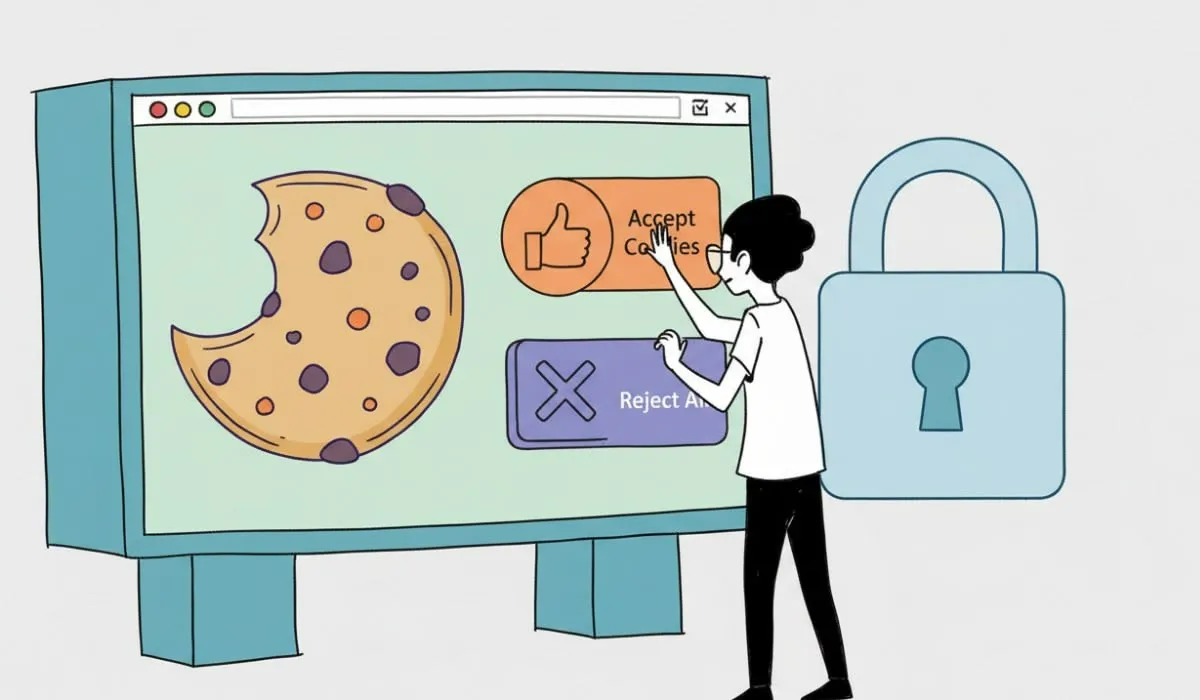
That phrasing — user choice — sounds empowering. In practice it's the opposite of how Safari and Firefox operate. Those browsers block third-party trackers by default, protecting people who never open a settings menu. Chrome leaves the trackers running and waits to see if you'll find the off switch yourself. Most people never will. Data brokers understand this perfectly, which is exactly why they're relieved. As long as you don't actively opt out, the legacy surveillance networks keep humming along, watching you move from site to site.
"The cleanup you assumed had happened simply didn't — and your privacy got handed back to you without anyone announcing it."
When the CMA released Google from its competition commitments on October 17, 2025, it confirmed the new reality bluntly: since Google "no longer plans to restrict" third-party cookies, the regulator's concerns "no longer arise." The cookie is here to stay, with no removal timeline anywhere in sight.
The Ad Industry's Scramble
You might think a reprieve for cookies would calm the advertising industry. It hasn't. Cookies survived, but they've grown unreliable — more people use privacy-focused settings, and consent rules under regulations like the GDPR and CPRA keep tightening. A tracker that works inconsistently is a problem for an industry built on precise measurement. So instead of relaxing, ad tech is hedging aggressively. Three workarounds are now front and center:
Server-side tracking
Rather than firing trackers from your browser where they can be blocked, companies route your data through their own servers first, then quietly forward it onward — out of reach of standard browser defenses.
First-party data collection
Sites push harder than ever to get you logged in, subscribed, or registered, because data you hand over directly sidesteps the cookie question entirely.
Alternative identifiers
When cookie data gets noisy, trackers lean on device fingerprinting and IP triangulation — methods that quietly rebuild a profile of you using signals you can't simply toggle off.
The uncomfortable point: none of these techniques depend on third-party cookies at all. Google's policy reversal didn't end tracking. It just gave the industry breathing room to diversify the ways it follows you.
Why You Are More Exposed Than Ever
The collapse left a trap that catches the average person off guard. Plenty of companies assume that because cookies technically survived, nothing legally or practically changed — so intrusive cross-site tracking continues unchecked across thousands of sites, with little new restraint.
Meanwhile the alternative identifiers keep advancing in the background. IP triangulation and deep device fingerprinting were never governed by Google's cookie policy in the first place, which means they sailed through the entire saga untouched. Whatever you gained from the idea of a cookie-free web, you didn't get it here.
And you still pay a daily tax in friction. Every site greets you with another manipulative consent banner, engineered to make "accept everything" the easiest button to press, because the tracking machinery underneath remains fully switched on. You're asked to consent, repeatedly, to a system that was supposed to be retired by now.
Enforce Your Privacy with Total Adblock
If the Privacy Sandbox story proves anything, it's this: waiting for browser makers or the ad industry to protect you is a losing bet. They spent six years and untold resources on a privacy project, then shelved it the moment it threatened revenue. Your defense has to come from somewhere you actually control. That's the gap the Total Adblock App is built to fill. Rather than asking you to memorize cookie menus or decode consent pop-ups, it works at the network level — stepping in the moment a page tries to load its tracking machinery. Using dynamic filtering, it intercepts third-party cookies, invisible tracking pixels, and the server-side telemetry scripts that the industry is now leaning on, cutting those connections before they can quietly build a profile of you.
It doesn't care which trick is in fashion — legacy cookie or fresh fingerprinting script, the request is stopped at the source.
It runs automatically in the background, so you don't trade away the websites you rely on to stay protected.
The legitimate features keep working while the surveillance gets starved of the data it was reaching for.
The web you use in 2026 isn't the privacy-respecting one you were promised. Third-party cookies live on, server-side tracking is spreading, and fingerprinting quietly fills any gaps. You can pick up that responsibility on your own terms — Total Adblock neutralizes legacy cookies, blunts cross-site profiling, and trims the heavy background tracking that drags down your pages, all without the constant tinkering that browser settings demand.
